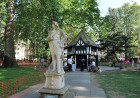
Temple Church
Discover Temple Church, London, where medieval architecture, legal heritage, and sacred calm create one of the city’s most inspiring landmarks.


Hidden within the legal heart of the city, Temple Church offers one of London’s most memorable encounters with the past. Tucked between Fleet Street and the River Thames, this remarkable church feels both secluded and central, a place where centuries of devotion, ambition, conflict, and renewal are gathered beneath ancient stone. For visitors seeking more than a checklist of landmarks, Temple Church reveals a quieter, deeper London—one shaped by faith, chivalry, law, and endurance.
Founded by the Knights Templar in the twelfth century, the church immediately stands apart from other sacred buildings in the capital. Its famous round nave, consecrated in 1185, reflects the Templars’ admiration for the Church of the Holy Sepulchre in Jerusalem. That circular design is not merely an architectural curiosity; it carries the memory of crusading ideals, pilgrimage, and a medieval worldview that linked London to the spiritual geography of the wider Christian world. To step inside is to enter a space designed to inspire awe, unity, and contemplation.
The first impression is often one of contrast. Outside, modern London moves at relentless speed, defined by chambers, offices, and traffic. Inside, time seems to slow. Light falls softly across pale stone. Arches rise with elegant restraint. The round church creates an atmosphere unlike the long rectangular forms many expect in English ecclesiastical architecture. It feels intimate yet monumental, simple yet charged with symbolism. Temple Church does not overwhelm with excess; it captivates through proportion, silence, and the dignity of survival.
A church shaped by the Templars
The Knights Templar were among the most powerful and enigmatic religious military orders of the medieval world. Established to protect pilgrims traveling to the Holy Land, they grew into a formidable international network with influence in warfare, finance, and politics. Their London headquarters became an important center of administration, and Temple Church stood at its spiritual core. The building therefore represents more than local parish history. It is a rare surviving witness to a movement that once connected England to continental Europe and the eastern Mediterranean.
That legacy continues to fascinate modern audiences, but the church rewards attention beyond legend. Its architecture speaks of discipline and purpose. The round nave evokes the ideals of sacred pilgrimage, while the later chancel, added in the thirteenth century, extends the building in a more traditional linear form. Together, these elements tell a story of growth and adaptation. Temple Church is not frozen in one historical moment; it is a living structure marked by changing needs, patrons, and identities.
Stone effigies and the memory of medieval power
Among the church’s most striking features are the recumbent stone effigies in the round nave. These sculpted knights, lying in solemn repose, have long captured the imagination of historians and visitors alike. Though often associated broadly with crusading romance, they are also deeply human memorials, reminders that the medieval world was built by individuals whose ambitions, loyalties, and fears were as real as our own. Their worn surfaces carry the touch of time, war, and restoration, yet they still project an extraordinary presence.
Standing near them, one senses how Temple Church preserves not only architecture but atmosphere. It is a place where memory is physical. Stone, floor, vault, and monument all participate in the act of remembrance. This is one reason the church leaves such a lasting impression: it allows history to be encountered not as abstraction, but as texture, space, and silence.
The church interiors featured in the 2006 film, The Da Vinci Code starring Tom Hanks.
From monastic order to legal tradition
After the suppression of the Knights Templar in the early fourteenth century, the site passed through new hands and new purposes. Over time, Temple Church became closely associated with the Inner Temple and Middle Temple, two of the Inns of Court that remain central to the legal life of England and Wales. This relationship gives the church a distinctive identity in London. It is both a sacred building and a spiritual home within one of the city’s most influential professional communities.
The legal setting enriches the experience of visiting. The surrounding lanes and courtyards, with their brick facades and formal calm, create a fitting approach to the church. Here, law and worship have existed side by side for generations, suggesting that public life requires more than argument and judgment alone. Temple Church offers a counterbalance: reflection, humility, and moral perspective. In a city often celebrated for power and commerce, that quiet witness feels especially valuable.
- Location: Nestled within the Temple area near Fleet Street.
- Historic origin: Founded by the Knights Templar in the twelfth century.
- Architectural highlight: A rare and celebrated round nave.
- Cultural significance: Deep ties to the Inns of Court and London’s legal heritage.
Endurance through fire and war
Like many great London landmarks, Temple Church has endured periods of severe damage and careful restoration. The building suffered during the Second World War, when bombing caused devastating destruction, including fire damage to the interior. Its restoration in the postwar years was not simply a technical act but a cultural one. Rebuilding Temple Church affirmed that places of beauty and memory matter, especially after violence. The restored church stands today as a symbol of resilience, proof that heritage can be renewed without losing its soul.
This resilience is part of what makes the church so moving. Visitors do not encounter an untouched relic, but a survivor. Every repaired surface and preserved detail speaks to the determination to carry history forward. In that sense, Temple Church mirrors London itself: wounded at times, transformed repeatedly, yet never stripped of its essential character.
Music, worship, and the experience of stillness
Temple Church is also renowned for its musical tradition. Choral services and concerts bring another dimension to the building, allowing its acoustics and spiritual character to merge. Sacred music in this setting can feel transcendent, as though the architecture itself were joining the performance. Even outside formal worship, the church invites a rare kind of attention. It encourages people to pause, look upward, and listen inwardly.
That is perhaps its greatest gift. In a city crowded with spectacular attractions, Temple Church offers something more enduring than spectacle. It offers stillness with depth. It reminds us that beauty can be disciplined, that history can be intimate, and that sacred places continue to matter even in a secular age. Whether one arrives as a historian, traveler, worshipper, or simply a curious walker, the church meets that visit with generosity.
- Enter slowly and take in the unusual geometry of the round nave.
- Spend time with the knightly effigies and notice their individual character.
- Explore the surrounding Temple precinct to appreciate the legal and historical setting.
- If possible, attend a service or musical performance for the fullest experience.
Temple Church, London, is not merely a monument to medieval grandeur. It is a place where architecture, memory, and purpose continue to speak to the present. Its stones tell stories of crusaders and lawyers, destruction and renewal, ceremony and silence. Above all, it stands as a reminder that the most powerful places are often those that invite us not only to observe history, but to feel its living presence. In that invitation lies the enduring inspiration of Temple Church: a sanctuary where London’s restless energy gives way, for a moment, to reflection, continuity, and grace.
The Temple Church